
Indian Air Force : Discipline at Altitude
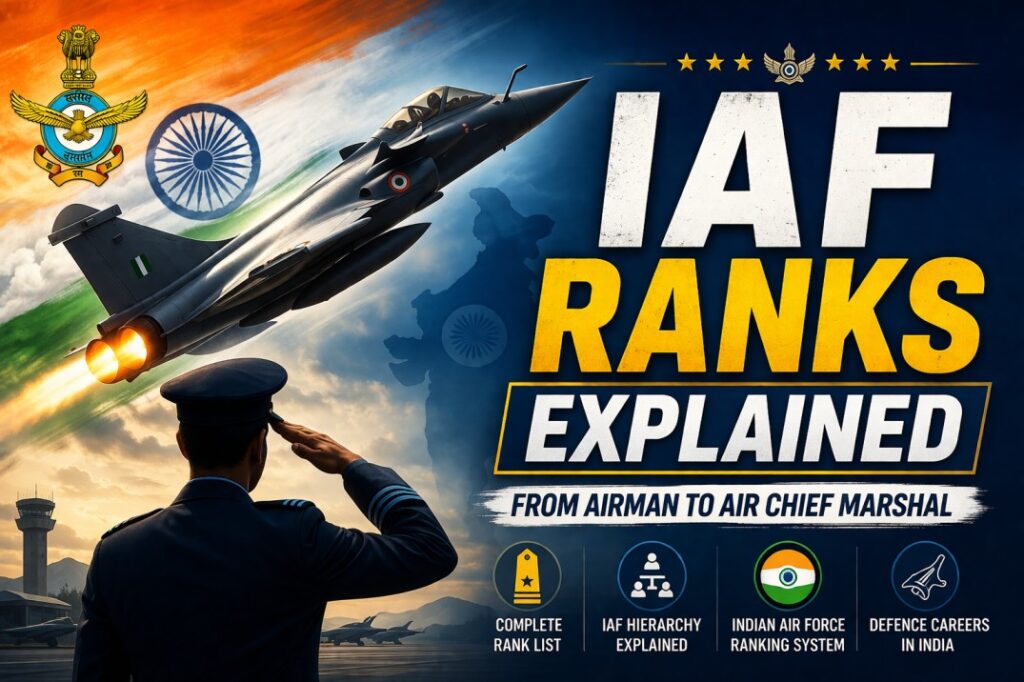
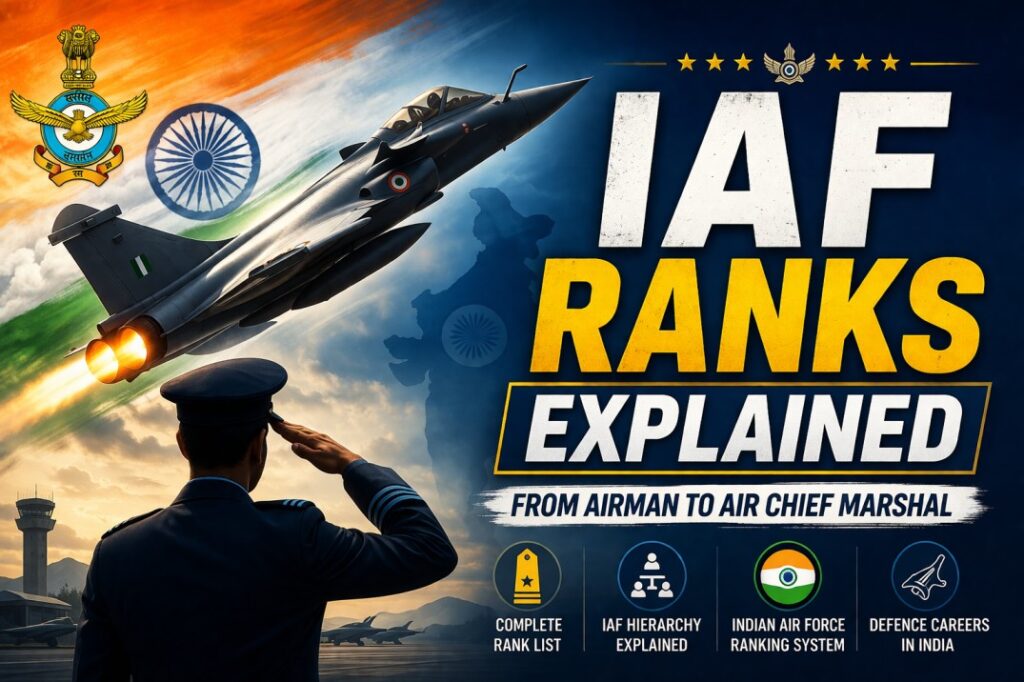
India’s security is not safeguarded solely by the Army standing guard on land or the Navy deployed at sea; rather, the Indian Air Force—vigilantly keeping watch over the skies—stands as one of the nation’s strongest pillars of defense. Whenever we speak of fighter jets, airstrikes, radar systems, or modern warfare technology, the name of the Indian Air Force is invoked with pride.
But have you ever wondered how the Indian Air Force’s ranking structure works? Which officer holds the highest position? What level of responsibility accompanies each rank? And what is the journey like—from starting as an Airman to rising to the rank of Air Chief Marshal?
The Indian Air Force (IAF) is the fourth largest air force in the world. According to Wikipedia, as of January 2025 the IAF has approximately 1,35,000 to 1,49,900 personnel in active service. Running an organisation of this scale smoothly demands a well-organised rank system.
The Indian Air Force rank structure is fundamentally based on that of the Royal Air Force (RAF) of the United Kingdom, but was adapted to the Indian context after independence in 1947. Each rank not only defines authority and responsibility — the insignia worn on the uniform becomes the officer’s very identity.
Have you ever dreamed of touching that blue sky where the brave officers of the Indian Air Force (IAF) soar on their missions? If yes, the first thing you need to understand is how the IAF rank structure works — because in this organization, every rank carries a distinct responsibility, a unique insignia, and a unique honor all its own.
How does the Indian Air Force ranking categories work?
The entire IAF rank structure is divided into three broad categories. Each has its own level of importance, responsibility, and career path:
- Commissioned Officers (COs): These are the IAF’s leaders — crafting strategy, commanding missions, and making high-level decisions are their domain.
- Junior Commissioned Officers (JCOs / Warrant Officers): They serve as the critical link between COs and the airmen — experience, discipline, and ground-level management define them.
- Airmen / Non-Commissioned Officers (NCOs): These personnel are the backbone of the IAF — aircraft maintenance, technical work, and logistics are in their capable hands.
Commissioned Officer Ranks — The Senior Leadership
In the IAF, commissioned officer service begins at the rank of Flying Officer. These officers join through NDA (National Defence Academy), AFCAT, or CDS examinations. Women can also join this category as pilots, ground duty officers, and technical officers.
Marshal of the Indian Air Force is the IAF’s highest honorary rank, carrying the distinction of five stars. In all of history it has been conferred only once — in January 2002 upon Air Chief Marshal Arjan Singh DFC, who gave extraordinary leadership to the IAF during the 1965 Indo-Pak War. This rank is bestowed by the President of India.
The Air Chief Marshal is the highest active rank in the IAF and is linked to the position of Chief of the Air Staff (CAS). In 2025 this position is held by Air Chief Marshal Amar Preet Singh. At any given time, there is never more than one serving ACM in the IAF.
Commissioned Officers-Ranking Table (Officer)
| Air Force Rank | Army Equivalent | Level | Key Responsibility |
|---|---|---|---|
| Air Chief Marshal | General | Top | Overall command of IAF |
| Air Marshal | Lt General | Senior | Leading major operatinal commands |
| Air Vice Marshal | Major General | Senior | Air base/ Senior staff roles |
| Air Commodore | Brigadier | Mid Senior | Brigade-level command |
| Group Captain | Colonel | Mid | Air Base/ Wing management |
| Wing Commander | Lt Colonel | Mid | Squadron/Wing Command |
| Squadron Leader | Major | Junior Senior | Flight command/ Training |
| Flight Lieutenant | Captain | Junior | Leading small teams |
| Flying Officer | Lieutenant | Entry | Entry-level commissioned officer |
Junior Commissioned Officers (JCOs) — A Treasury of Experience
COs are senior personnel who reach this level on the strength of years of dedicated service and expertise. They play the role of a “bridge” between commissioned officers and airmen — day-to-day operations, discipline, and unit-level personnel management are their core responsibilities.
| Rank | Insignia Features |
|---|---|
| Master Warrant Officer (MWO) | IAF Crest + Wreaths |
| Warrant Officer (WO) | IAF Crest |
| Junior Warrant Officer (JWO) | Eagle + Star combination |
Airmen & NCOs — The True Backbone of the IAF
| Rank | Promotion Timeline |
|---|---|
| Aircraftman (AC) | Entry Level |
| Leading Aircraftman (LAC) | After ~2 years |
| Corporal | After ~5 years |
| Sergeant | After ~13.5 years |
Conclusion: The Sky Is Waiting for You
The Indian Air Force rank structure is not merely a list of designations — it is a complete philosophy of life, built on discipline, service, courage, and patriotism. Every step from Aircraftman to Air Chief Marshal tells a story of years of hard work, dedication, and sacrifice.
Whether you dream of becoming an Agniveer Vayu under the Agnipath scheme, aspire to become a Flying Officer through AFCAT, or are planning to join the IAF via NDA — every path leads to that blue sky where the pride of India soars.
🚀 Take Your First Step Toward Your IAF Dream!
Are you considering a career in the Indian Air Force? Drop your target rank in the comments below, share this post with friends who aspire to a Defence career, and follow our blog Indian Army Entrance Exam Dates for more in-depth guides like this one. Also Visit the IAF Official Career Page →